At A Foundation Building Strength (AFBS), our core mission is driving the scientific discoveries needed to develop effective treatments for Nemaline Myopathy and finding viable genetic therapies for rare neuromuscular disorders requires innovative engineering alongside persistent investment. Through targeted grant funding and research partnerships, AFBS bridges the gap between early laboratory concepts and translational pipelines. Recent breakthroughs in Nemaline Myopathy gene therapy are moving preclinical science closer to clinical reality, and our community’s support continues to accelerate targeted solutions for the two most common genetic causes of NM: NEB and ACTA1.
Mini-Nebulin Gene Therapy for NEB-Related Nemaline Myopathy (Lead Investigators: Dr. Jim Dowling & Dr. Hichem Tasfaout)
Mutations in the nebulin (NEB) gene account for roughly half of all Nemaline Myopathy cases, causing muscle weakness, low tone, respiratory issues, feeding difficulties, and motor delays. The nebulin protein is exceptionally massive, so standard adeno-associated virus (AAV) delivery vectors can’t fit the entire gene sequence into a single package.
Dr. Dowling & Dr. Tasfaout are addressing this size barrier by developing a split-intein approach, and this strategy represents a crucial step forward for Nemaline Myopathy gene therapy targeting large genes. The team divides the gene into smaller fragments that fit inside standard AAV vectors, and these fragments deliver instructions to the muscle to produce protein sections designed to self-assemble in the proper order into functional nebulin.
- Intein Design and Splicing: The team successfully generated and tested a 3-fragment intein construct that splices together as expected to create a functional protein at 43% of full-length nebulin, and they have also completed designs for 4-fragment and 5-fragment nebulin with initial in vitro testing confirming successful protein splicing.
- In Vivo Testing Models: Animal studies are beginning with a humanized nebulin disease mutation mouse model (exon55 del), allowing the team to assess vector delivery, muscle strength, structure, motor function, and survival.
- Expanded Disease Assessment: The lab has integrated a second nonsense-mutation mouse model, and testing therapies across both lines allows the team to evaluate treatment efficacy across varying clinical severity levels.
- Next Steps: AAV production containing the 3-fragment construct is on schedule, and immediate mouse model injections will follow as soon as the vectors are ready.
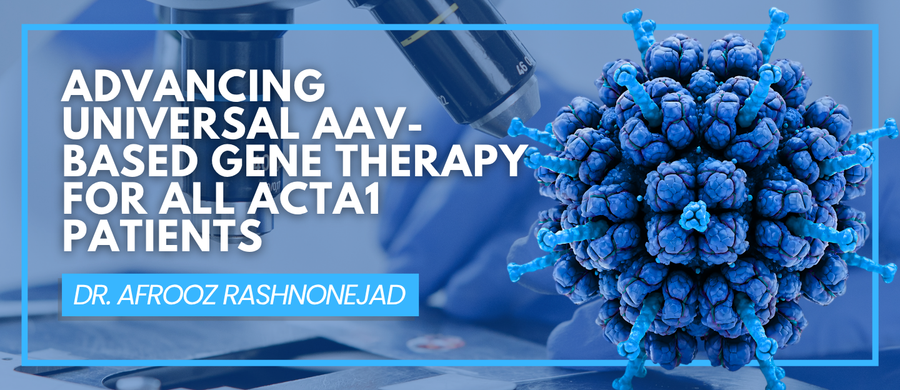
Advancing Universal AAV-Based Gene Therapy for All ACTA1 Patients (Lead Investigator: Dr. Afrooz Rashnonejad)
The ACTA1 gene produces skeletal muscle alpha-actin, which is essential for normal muscle contraction and strength. Certain ACTA1 mutations may also interfere with cardiac actin (ACTC1), so some patients develop dangerous cardiac complications in addition to skeletal muscle weakness. Dr. Rashnonejad’s team is engineering a universal Nemaline Myopathy gene therapy designed to treat all individuals with ACTA1 mutations, and this single approach aims to protect both skeletal and cardiac muscle tissues.
- Beating Heart Cell Disease Models: The team generated patient-derived stem cells from donated skin samples, and they successfully turned these cells into beating cardiac cells in the lab. These cells exhibited slower and less forceful contractions compared to healthy cells, so researchers now have a direct human model to evaluate whether the therapy can prevent or reverse cardiac dysfunction.
- Vector Preparation: The lab prepared the DNA materials necessary to manufacture high-yield AAV vectors, and these batches will supply upcoming preclinical animal studies.
- Next Steps: The next phase focuses on evaluating cell functional recovery, and the team will launch dosing experiments in ACTA1 mouse models to determine the optimal safety window and therapeutic dosage for muscle rescue.
Every step forward in the lab brings the entire NM community closer to clinical breakthroughs, and our funded investigators continue to push the boundaries of genetic medicine. By exploring novel delivery systems like split-inteins and engineering universal platforms for cardiac and skeletal muscle, AFBS remains steadfast in funding the foundational Nemaline Myopathy gene therapy research necessary to make life-changing treatments a reality.
A Foundation Building Strength (AFBS) is a nonprofit organization dedicated to accelerating the development of treatments for Nemaline Myopathy. Our mission is to fund cutting-edge research to find effective treatments while providing resources and a strong community for families affected by NM. We are proud to be at the forefront of driving Nemaline Myopathy research breakthroughs forward through collaborations with research teams across the globe.
Donate to AFBS: Your monetary gift will support critical research and provide vital resources for NM families.
Stay Connected: Sign up for our email list to receive the latest updates from AFBS and learn more about NM research.
Are you an individual or a caregiver of an individual affected by NM? Fill out the AFBS Contact Survey to be connected with valuable resources, support, and research opportunities! Visit our “Get Involved” page for even more ways to connect!