At A Foundation Building Strength (AFBS), we’re striving to give Nemaline Myopathy patients access to effective treatment, regardless of how rare their specific genetic “typo” might be. We are excited to provide an update on the ground-breaking work of Dr. Afrooz Rashnonejad, a Principal Investigator at the Center for Gene Therapy at Nationwide Children’s Hospital.
As a vital part of AFBS’s recent $3.6 million research commitment, Dr. Rashnonejad’s research is pioneering a universal gene therapy for ACTA1-related Nemaline Myopathy (NEM3), a breakthrough strategy designed to bring hope to the NM community.
The Challenge: A Numbers Game for ACTA1 Gene Mutations
The ACTA1 gene provides the blueprint for a protein essential to muscle contraction. A major challenge in treating this form of NM is the sheer variety of mutations: over 200 distinct variations can cause the disease.
In the world of rare disease, designing a “bespoke” therapy for every single variation is a logistical and economic impossibility. Dr. Rashnonejad’s research flips this narrative, moving away from individual fixes toward a mutation-independent universal gene therapy for ACTA1.
The “KDAR” Strategy: A Universal Eraser and Pen
Dr. Rashnonejad’s team utilizes a sophisticated process known as “Knockdown and Replace” (KDAR). Because ACTA1-related NM is typically inherited in an autosomal dominant manner, a single “bad” copy of the gene produces toxic proteins that clog the muscle. To find a successful treatment, you cannot simply add a healthy gene; you must first silence the harmful one.
Think of this universal gene therapy for ACTA1 as a Genetic Eraser and Pen:
- The Eraser (Knockdown): The therapy delivers specialized microRNAs (miRNAs) that act as a “molecular mute button,” silencing the expression of both the healthy and defective genes to stop the production of toxic proteins.
- The Pen (Replace): Simultaneously, the therapy uses a “MyoAAV” vector– a cutting-edge vehicle designed specifically for muscle– to write in a new, healthy version of the gene (rACTA1). This replacement is “invisible” to the eraser, allowing it to function unimpeded.
Promising Results: Functional Recovery in Models
The team tested this universal gene therapy for ACTA1-related NM in the H40Y mouse model with encouraging results. By 12 weeks of age, treated mice demonstrated a significant recovery of grip strength, reaching “near wild-type levels.” In humans, grip strength is a vital proxy for quality of life, representing the ability to interact with the world and perform daily tasks.
Under the microscope, the impact was even more striking:
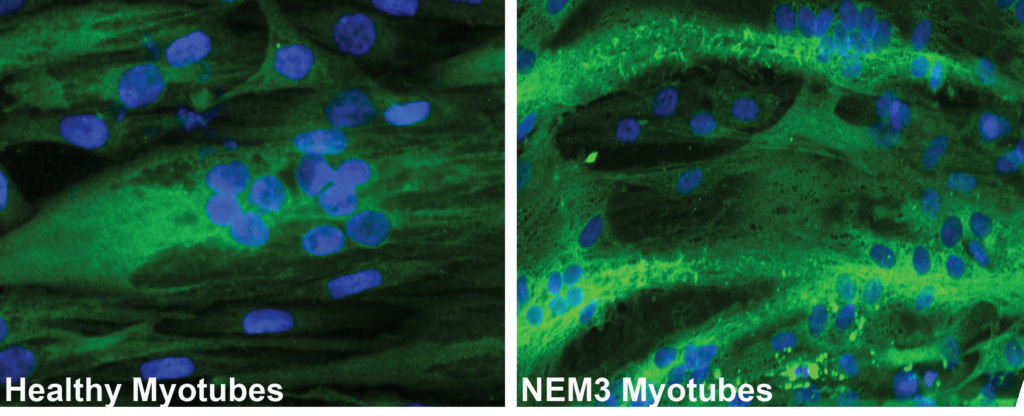
- Cellular Housekeeping: The therapy cleared a significant proportion of “nemaline bodies”—the protein clumps that prevent proper muscle contraction.
- Molecular Success: In the Triceps, the treatment achieved a ~50% reduction in mutant gene activity while driving a staggering 80-to-90-fold increase in the expression of the healthy replacement gene.
Looking Ahead to 2026
While these results are a major proof-of-concept, the next phase of research is critical. Supported by new AFBS funding beginning in 2026, Dr. Rashnonejad will focus on identifying the optimal “treatment window”—finding the best age for intervention to ensure maximum efficacy and long-term safety for this universal gene therapy for ACTA1-related NM.
By successfully erasing a wide spectrum of mutations and overwriting them with a single healthy blueprint, Dr. Rashnonejad’s work offers more than just hope for patients with ACTA1-related Nemaline Myopathy—it provides a template for the future of genomic medicine in treating neuromuscular disorders.
Support research like Dr. Rashnonejad’s by joining our mission. Stay updated on the latest breakthroughs by signing up for our newsletter.
A Foundation Building Strength (AFBS) is a nonprofit organization dedicated to accelerating the development of treatments for Nemaline Myopathy. Our mission is to fund cutting-edge research to find effective treatments while providing resources and a strong community for families affected by NM. We are proud to be at the forefront of driving Nemaline Myopathy research breakthroughs forward through collaborations with research teams across the globe.
Donate to AFBS: Your monetary gift will support critical research and provide vital resources for NM families.
Stay Connected: Sign up for our email list to receive the latest updates from AFBS and learn more about NM research. Are you an individual or a caregiver of an individual affected by NM? Fill out the AFBS Contact Survey to be connected with valuable resources, support, and research opportunities! Visit our “Get Involved” page for even more ways to connect!
I am speaking from Bangladesh. My daughter is 2.8 years old. She has nemaline myopathy 2. She can stand without Gower sign. But there is a problem. She can’t stand up to 3 inches without holding on. If she is older, she can stand up on one knee without holding on. She can run a little. She has a problem with going up and down. And she has a problem with chewing hard things. Should I give her medicine now? What else should I do?
Hi Rozy! Thanks so much for reaching out concerning your daughter. While there are currently no approved treatments for Nemaline Myopathy, we’d love to connect you with resources, community support, and information to help you moving forward. As a first step, I recommend completing the AFBS Community Contact Survey found here: https://www.surveymonkey.com/r/AFBS-Contact-List. This will allow us to connect you with relevant resources and potential future studies. Additionally, we would be happy to add you to our email list to keep you informed about the latest research advances, community events, and AFBS news.